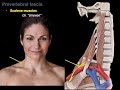
This tutorial focuses on muscles of the neck:
0:00. Intro to muscles of the neck
0:17. Explanation of approach teaching neck muscles via cervical fascia
0:35. Superficial fascia muscle – Platysma
1:40. Deep investing fascia muscles – Sternocleidomastoid and Trapezius
3:41. Prevertebral fascia muscles – Anterior scalene, Middle Scalene, Posterior scalene, Levator scapulae, Longus capitis, Longus colli
7:47. Pretracheal fascia muscles – Infrahyoid muscles (Sternohyoid, Sternothyroid, Omohyoid, Thyrohyoid)
9:58. Why are both somatic body wall muscles and branchial arch muscles found in the neck?
11:48. Review (In a nutshell)
11:55. Acknowledgments
Official Ninja Nerd Website: https://ninjanerd.org
Ninja Nerds!
In this lecture Professor Zach Murphy will present on the anatomy of the upper limb. This will include the muscles that make up the shoulder, arm, wrist, and hand on a SOMSO anatomy model! We hope you enjoy this lecture and be sure to support us below!
Join this channel to get access to perks:
https://www.youtube.com/channel/UC6QYFutt9cluQ3uSM963_KQ/join
THIS VIDEO EXPLAINS ABOUT BONES AND MUSCLES .IT EXPLAINS ABOUT JOINTS, TYPES OF MUSCLES, FOOD FOR GOOD AND HEALTHY BONES AND MUSCLES, AND POSTURE . THIS VIDEO ALSO GIVES MANY THINKING QUESTIONS FOR KIDS TO ANSWER LIKE A QUIZ.
For more videos please visit :
https://www.youtube.com/channel/UCW7WugaHVra-5NaONjZmwGQ
Make It Easy education is the passport to the knowledgeable future.
Our main motive is to educate and encourage students to think wisely in the different field. Make It Easy Education makes learning a easy process.It can be viewed by anyone within any age group. The information is easy and simple to understand .
Make It Easy Education aims in making your competitive life easier. Video Rating: / 5
The Doctors welcome bodybuilder Uzoma Obilor who is not only ripped but his muscles actually ripple and he’s come to the show find out why.
Subscribe to The Doctors: http://bit.ly/SubscribeTheDrs
Like us on Facebook: http://bit.ly/FacebookTheDoctors
Follow us on Twitter: http://bit.ly/TheDrsTwitter
Follow us on Instagram: http://bit.ly/InstagramTheDoctorsTV
Follow us on Pinterest: http://bit.ly/PinterestTheDrs
About The Doctors:
The Doctors is an Emmy award-winning daytime talk show hosted by ER physician Dr. Travis Stork, plastic surgeon Dr. Andrew Ordon and OB-GYN Dr. Nita Landry.
The Doctors helps you understand the latest health headlines, such as the ice bucket challenge for ALS and the Ebola outbreak; delivers exclusive interviews with celebrities dealing with health issues, such as Lamar Odom, Teen Mom star Farrah Abraham, reality stars Honey Boo Boo and Mama June, and activist Chaz Bono; brings you debates about health and safety claims from agricultural company Monsanto and celebrities such as Jenny McCarthy; and shows you the latest gross viral videos and explains how you can avoid an emergency situation. The Doctors also features the News in 2:00 digest of the latest celebrity health news and The Doctors’ Prescription for simple steps to get active, combat stress, eat better and live healthier.
Now in its eighth season, The Doctors celebrity guests have included Academy Award Winners Sally Field, Barbra Streisand, Jane Fonda, Marcia Gay Harden, Kathy Bates and Marisa Tomei; reality stars from Teen Mom and The Real Housewives, as well as Kris Jenner, Caitlyn Jenner, Melissa Rivers, Sharon Osbourne, Tim Gunn and Amber Rose; actors Jessica Alba, Christina Applegate, Julie Bowen, Patricia Heaton, Chevy Chase, Kristin Davis, Lou Ferrigno, Harrison Ford, Grace Gealey, Cedric the Entertainer, Valerie Harper, Debra Messing, Chris O’Donnell, Betty White, Linda Gray, Fran Drescher, Emmy Rossum, Roseanne Barr, Valerie Bertinelli, Suzanne Somers; athletes Magic Johnson, Apolo Ohno and Danica Patrick; musicians Tim McGraw, Justin Bieber, Clint Black, LL Cool J, Nick Carter, Kristin Chenoweth, Paula Abdul, Gloria Gaynor, La Toya Jackson, Barry Manilow, Bret Michaels, Gene Simmons and Jordin Sparks; and celebrity chefs Wolfgang Puck, Guy Fieri and Curtis Stone. Video Rating: / 5
In this educational video children can learn about the muscles of the body and how those muscles helps us move. This video covers many major muscles such as biceps, triceps, abs, and quadriceps, watch to learn more!
This video is part of a collection of videos about the human body, where children can learn about different parts and systems of the body.
Thanks for visiting us! If you want your children to smile and learn, subscribe! 😀
We only upload our own content, designed by educators so that children smile and learn while watching a video.
All of our content reinforces educational values, encouraging the use of multiple intelligences and language learning.
If you like our videos, download “The Smart Library” now. You’ll discover more than 70 interactive games and stories for children designed by educators. The stories are based on VALUES like friendship, respect, and generosity, and our games cover all of the MULTIPLE INTELLIGENCES. All our content is in SPANISH, ENGLISH, FRENCH, ITALIAN and PORTUGUESE.
Thank you for trusting us with your children’s education! Video Rating: / 5
The muscles of the hip and thigh keep your hip joints strong and mighty, allowing for a wide range of hip movements. Now that you watched the video, you should be ready to take a quiz here: https://khub.me/ygfdu
Oh, are you struggling with learning anatomy? We got the ★ Ultimate Anatomy Study Guide ★ to help you kick some gluteus maximus in any topic. Completely free. Download yours today: https://khub.me/t7yro
In this tutorial, we will be covering the origins, insertions, innervation, blood supply and functions of all the muscles found on the hip and thigh. Those are muscles that are attached mainly to the femur and the hip bones.
On the video, the different muscles will split into the different muscle groups where they are usually found. Some schools define the groups by function, but on this tutorial we will define the groups by their location. The hip muscles are going to be slip into hip muscles and gluteal muscles. While the thigh muscles will be slip into the anterior, medial and posterior groups.
Want to test your knowledge on the muscles of the hip and thigh? Take this quiz: https://khub.me/ygfdu
Read more on the anatomy and functions of the different muscles of the hip and thigh, like the iliopsoas muscle: https://khub.me/xghjl
For more engaging video tutorials, interactive quizzes, articles and an atlas of Human anatomy and histology, go to https://khub.me/mtym0 Video Rating: / 5
Visit http://www.makemegenius.com ,watch all human body systems & other science educational videos for kids for free.
Meaning and Definition – Muscles in an average human body constitute 40% of the body’s weight ,there about 600 muscles in a human body.All these muscles put together form muscular system.The muscular system is a network of muscles and tissues which control the body’s movement. All the activities which the body performs (i.e., jumping ,smiling & running etc.) happen due to the contraction and relaxation of the muscles.
Ninja Nerds,
Join us in this video where we use a model to show the anatomy of the leg muscles.
***PLEASE SUPPORT US***
PATREON | https://www.patreon.com/NinjaNerdScience
***EVERY DOLLAR HELPS US GROW & IMPROVE OUR QUALITY***
Learn about the definition and terminology of the muscular system in our video tutorial. Expand your knowledge with our quiz: http://khub.me/6auc4
Oh, are you struggling with learning anatomy? We created the ★ Ultimate Anatomy Study Guide ★ to help you kick some gluteus maximus in any topic. Completely free.
Download yours today: https://khub.me/0ovgc
In this video tutorial we will take a look at how the names of the muscles of the human body are derived. Learning and understanding the terminology and definition of anatomical terms is one of the most basic skills every student needs to acquire, so they can describe and discuss anatomical issues in lectures and courses with other students or lecturers in a precise fashion.
We will take a closer look and give examples for how muscles are named after their shape, size, muscle fibre orientation, action, and more, so you will become fluent in talking about the different aspects of the muscular system.
1:21 Shape
3:03 Size
4:40 Orientation of fibers
5:50 Muscle action
7:05 Number of attachments
7:42 Points of attachments
8:00 Muscle location
9:23 Summary
Want to test your knowledge on the main muscles in the human body? Take this quiz: http://khub.me/6auc4
Read more on what muscles are actually made of in our free article, for a deeper understanding of one of the most important systems in our body: https://khub.me/7j5a4
For more engaging video tutorials, interactive quizzes, articles and an atlas of Human anatomy and histology, go to https://khub.me/atgh4
The skeletal muscle system is ready to contract,
It’s there when you need to fight and also to react,
You have around 640, but there’s no need to fear,
We’ll cover all the main ones – from your front to your rear!
There’s the trapezius muscle, from your neck down your back,
This muscle has three portions, so let us discuss that!
Superior, middle, inferior – that is what they’re called!
And around your shoulders, is where they are sprawled!
The deltoids top the shoulders, and each splits into three,
Anterior, lateral, posterior fibers as you can see,
These muscles help you lift your arms up into the air,
So you can wave your arms around like you don’t even care.
The biceps is a flexor, made up of two sections,
The short and the long heads, almost like reflexions.
The triceps is an extensor, with three bits you can see,
These are the lateral, long, and the medial heads actually.
Your two pecs help move your arms and they are on your chest,
Know that these muscles come in pairs, like weights that are bench pressed.
The pectoralis major lets you move your humerous,
The minor muscle lifts your ribs, as you’ll know if you are studious.
The rhomboids on your upper back let you dance your best,
The minor above major, remember for your test!
Your lats can be seen behind, always by your side,
Of all of your back muscles, these are the most wide!
The obliques help you rotate, and are found along your sides,
Beneath the external, the internal oblique hides.
The rectus abdominis, which are often called your abs!
Everyone has a six-pack, though sometimes under flab!
Glutes are the largest muscles, located on your rear,
Your glutes will help you to climb stairs without any fear.
The three gluteal muscles are maximus, medius, minimus,
So make sure when you study, that you are not oblivious.
The quadriceps has four muscles, which help extend your knee,
It’s found atop the femur, shown here as you can see.
Vastus lateralis, intermedius, medialis
Together with the fourth, called rectus femoris.
The hamstrings are leg flexors and they have three muscles,
Biceps femoris, semitendinosus, semimembranosus,
Finally your calf muscles – the soleus and gastrocnemius,
With lateral and medial heads, which find cycling strenuous.
In this muscles for kids video you will get a fun introduction that teaches young kids all about the muscular system and highlights the various muscles of the body. In this video we highlight Cardiac, Skeletal and Smooth muscles with examples in each category and their purposes.
We also learn about Voluntary and Involuntary muscles with examples and teach about their purposes as well! We hope you enjoy sharing this Introduction to muscles video with your children and students.
This video is designed to be a teaching resource for k-6 classrooms and at home learning.
Subscribe to our channel to be notified when we release new videos!
Are you a K-6 grade teacher or homeschooling parent looking for more teaching resources? We don’t only provide video content but high quality lesson plans as well. Our lessons are 100% free with handouts, worksheets, classroom activities and more! Check us out!
More Science Videos: https://www.youtube.com/playlist?list=PLyqf1JCzOf_nBNCibt2BQi-hLBCzgHrMt
Thank you for following Clarendon Learning. Clarendon Learning is a non-profit that was organized with the sole purpose to aid in the education and strengthening of America’s youth. Clarendon Learning hopes to create bright futures for children across the country by supporting teachers and parents, and developing high quality educational content for kids.
LOOK MORE MUSCULAR WORKOUT | THENX
1. PULL UPS (WIDE GRIP)
2. AUSTRALIAN PULL UPS (WIDE, SHOULDER, CLOSE GRIP)
3. HANDSTAND PUSH UPS + SHOULDER TAPS
4. UPSIDE DOWN DEAD LIFT
5. HANGING LEG RAISES + KNEE RAISES
6. PLANK SIDE TO SIDE
7. DUMBBELL SHRUGS
8. CHIN UPS + HEADBANGERS
9.DUMBELL LATERAL FLY + REAR DELT FLY
8-15 REPS EACH EXERCISE
REPEAT ROUTINE 4X TO COMPLETE WORKOUT
BUY THENX IGNITE PREWORKOUT: https://thenx.com/shop
THENX Iphone App: https://goo.gl/Qk235s
ANDROID App: https://goo.gl/kcRBpL
SHOP THENX APPAREL: https://thenx.com/apparel
Thenx Blog about this workout http://thenx.com/blog/
Start Now & Unleash the Athlete in you!
Available Anywhere On Any Device.
BECOME A THENX MEMBER: https://thenx.com/
AND GET FULL ACCESS TO ALL OUR PROGRAMS & WORKOUTS
– DOWNLOAD OUR THENX APP: https://goo.gl/Qk235s
&TAKE OUR WORKOUT PROGRAMS WITH YOU EVERYWHERE!
– WORKOUT FROM HOME
-THE PARK
-THE GYM
– NEW CONTENT ADDED DAILY
The BEST Calisthenics App, secret techniques, programs, and step by step guided tutorials tested by thousands of people to reach their goals, with the most simplistic systematic approach to learning any calisthenics move such as the Handstand, Muscle Up, Planche, with ease.
And it’s all IN HERE
https://WWW.THENX.COM Video Rating: / 5
Hank calls in a friend to do his push ups for him today to explain how skeletal muscles work together to create and reverse movements. Hank and Claire also demonstrate the role size plays in motor units, the three phase cycle of muscle twitches, and how the strength and frequency of an impulse affects the strength and duration of a contraction. This episode also explains twitch summation, tetanus, and isotonic vs. isometric movements.
Pssst… we made flashcards to help you review the content in this episode! Find them on the free Crash Course App!
Download it here for Apple Devices: https://apple.co/3d4eyZo
Download it here for Android Devices: https://bit.ly/2SrDulJ
Table of Contents
Skeletal Muscles Work Together to Create and Reverse Movements 1:14
Motor Units 3:52
Three Phases of Muscle Twitches 4:41
Strength and Frequency of Impulses 5:29
Strength and Duration of a Contraction 5:29
Twitch Summation vs Tetanus 6:19
Isotonic vs Isometric Movements 8:50
Crash Course is now on Patreon! You can support us directly by signing up at http://www.patreon.com/crashcourse
Thanks to the following Patrons for their generous monthly contributions that help keep Crash Course free for everyone forever:
Mark Brouwer, Jan Schmid, Steve Marshall, Anna-Ester Volozh, Sandra Aft, Brad Wardell, Christian Ludvigsen, Robert Kunz, Jason, A Saslow, Jacob Ash, Jeffrey Thompson, Jessica Simmons, James Craver, Simun Niclasen, SR Foxley, Roger C. Rocha, Nevin, Spoljaric, Eric Knight, Elliot Beter, Jessica Wode
***SUBBABLE MESSAGES***
TO: Ariela
FROM: Gavi
I love you so much, stay awesome as always!
—
TO: Josiah P.
FROM: Amy P.
I love you!
***SUPPORTER THANK YOU!***
Thank you so much to all of our awesome supporters for their contributions to help make Crash Course possible and freely available for everyone forever:
Vanessa Benavent, Les Brown, John Hadfield, Damian Shaw, Burt G. Clothier & Tad A. Saine, Ashley Williamson, Carrie Williamson, Melissa A, Lopin Forsythe, Trevor Sacks
—
Want to find Crash Course elsewhere on the internet?
Facebook – http://www.facebook.com/YouTubeCrashCourse
Twitter – http://www.twitter.com/TheCrashCourse
Tumblr – http://thecrashcourse.tumblr.com
Support Crash Course on Patreon: http://patreon.com/crashcourse